3D Van Configurator Case Study: How VanHaven Lets Customers Design £100K+ Custom Vans Online
How we built a 3D van configurator for VanHaven — a luxury VW Transporter conversion company — allowing customers to design bespoke vans with full exterior and interior customisation, 360° views, and PDF brochure generation.
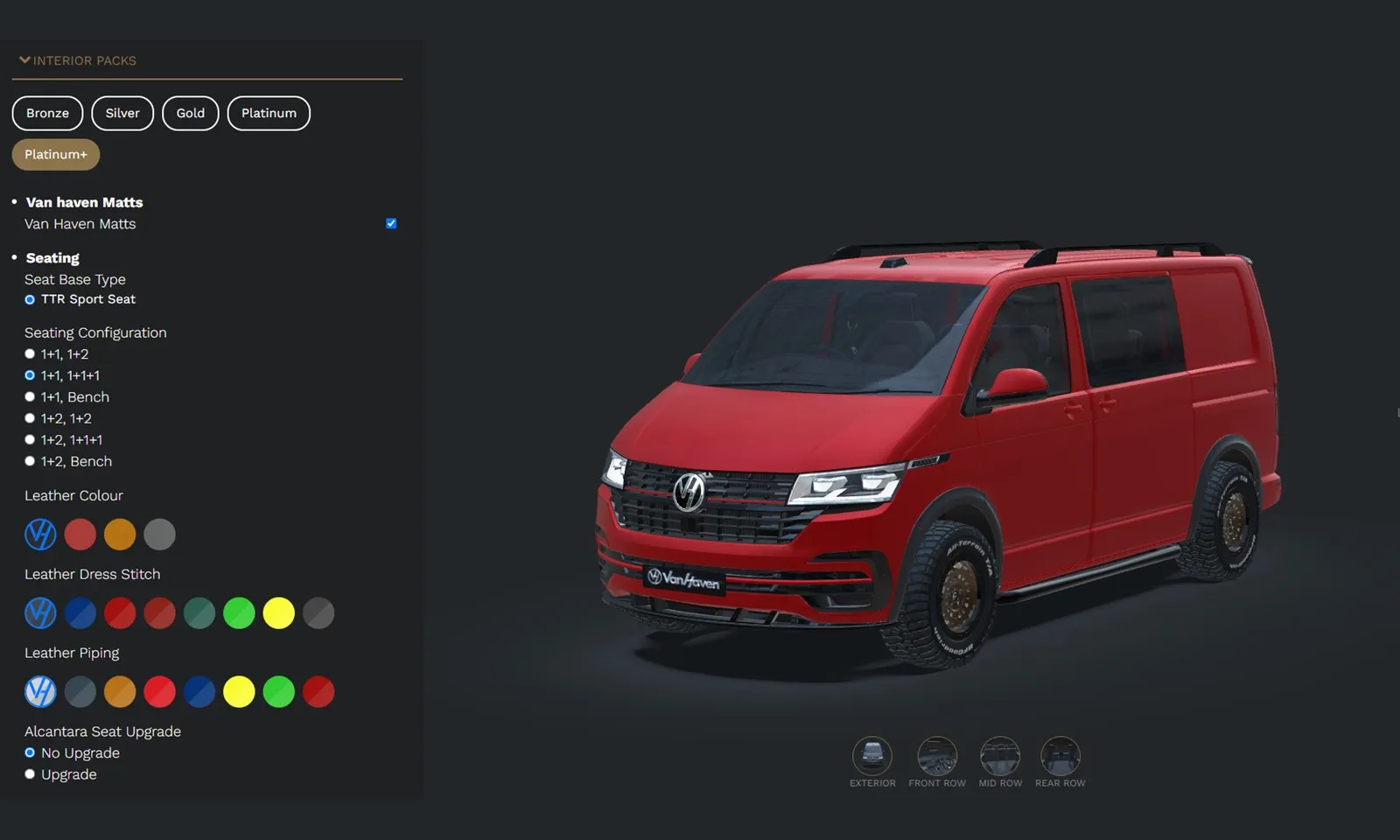
VanHaven builds bespoke VW Transporter conversions that sell for over £100,000. Each van is handcrafted in Dorset — leather interiors, custom body kits, premium alloys, and tiered packages from Bronze to Platinum Plus. Their customers aren't buying off the shelf. They're commissioning a vehicle tailored to their exact specifications.
The problem: how do you sell a £100K+ bespoke product online when every build is different?
Static photos show one configuration. A price list shows options. But neither lets a buyer see their van — the exact colour, the exact wheels, the exact interior — before committing to a build that takes weeks to complete.
That's the gap we were asked to close.
The Challenge
VanHaven's sales process is consultative. Customers visit the HQ in Dorset, speak with a design consultant, and work through options in person. It's a concierge experience — and it works. But it doesn't scale to every prospect browsing the website at midnight, wondering what a Fortana Red exterior with 20-inch Wolfsburg alloys and a Platinum Plus interior would look like.
Before the configurator, VanHaven relied on gallery photos and social media to showcase their builds. With 69,000+ Instagram followers, their visual content was already strong. But every photo showed someone else's van. Prospective buyers had to imagine their own.
For a product at this price point, imagination isn't enough. The gap between "I like what I see" and "I can see exactly what I'm buying" is where hesitation lives — and where deals stall.
VanHaven needed an interactive tool that would let customers:
- Select a base van type and wheelbase (Kombi, Caravelle, Shuttle, Panel Van)
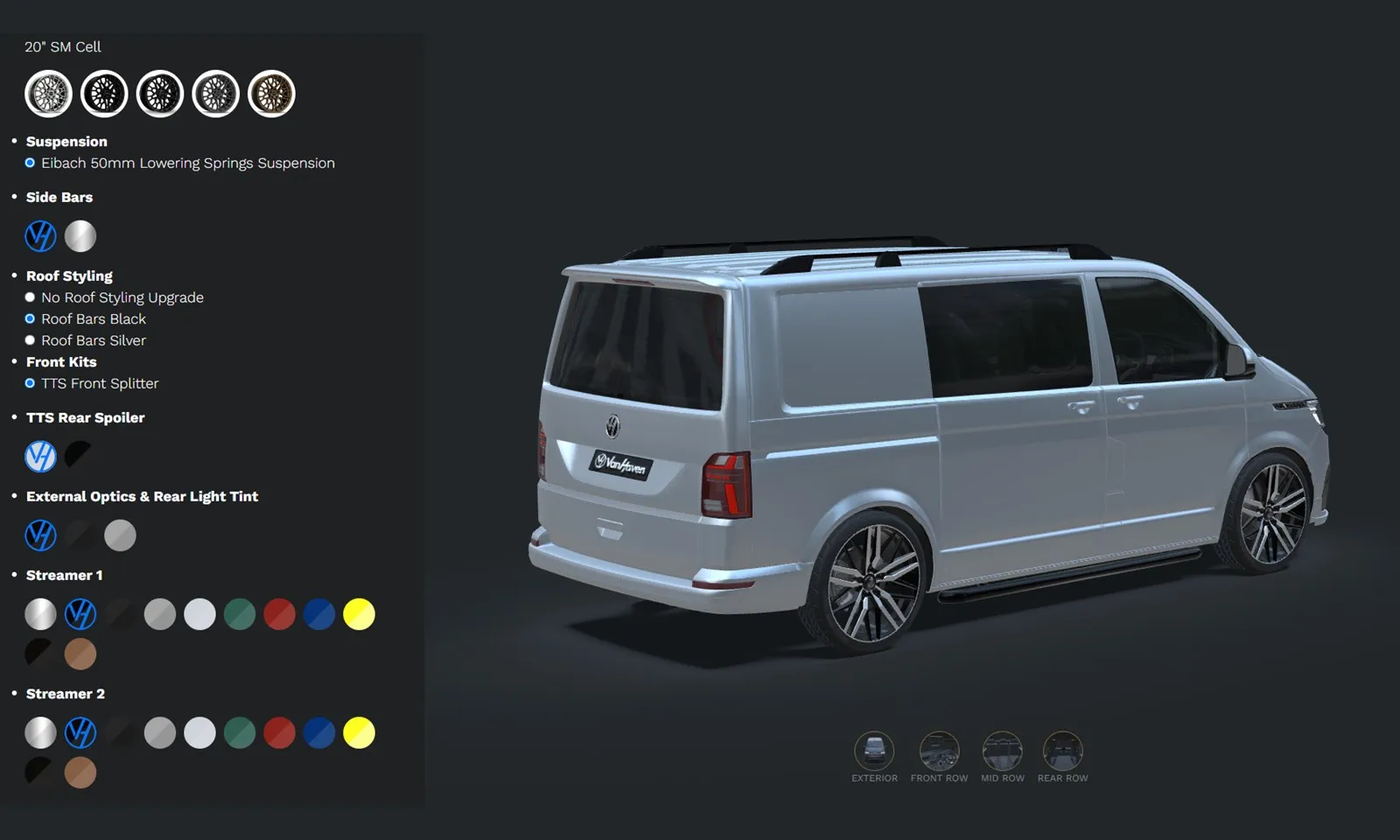
- Customise the exterior — body colour, alloy wheels, body kits, roof styling, side bars, suspension
- Customise the interior — seating layout, leather colours, stitch options, Alcantara trim, dashboard surrounds, audio systems
- View the result in 3D with 360° rotation and multiple camera angles
- Generate a PDF brochure of their configured van to share or bring to a consultation
And they needed it built within three months, at a cost that made commercial sense for a growing business — not a six-figure enterprise software budget.
The Approach: Pragmatic Technology Choices
Every configurator project starts with a build-versus-buy decision on the rendering layer. Do you build a custom 3D engine from scratch using Three.js and WebGL, or leverage an existing rendering platform and focus your development effort on the product experience?
For VanHaven, the answer was clear. Building a custom rendering engine would have added months to the timeline and significantly increased the budget — without delivering a better experience for VanHaven's customers. The rendering itself wasn't the differentiator. The product experience was.
We selected Unlimited3D for the rendering layer. It provided the real-time 3D engine, model hosting, and material system out of the box. We then built everything else around it: the frontend interface, the configuration logic, the API integration layer, the camera system, and the brochure generation — all custom-developed to match VanHaven's brand and sales process.
This is a pattern we recommend for projects where timeline and budget are constrained but the product experience needs to feel fully bespoke. We used a similar approach for Hulck's industrial trailer configurator, integrating Expivi with WordPress. You get production-grade 3D rendering without the cost of building it from scratch, and you invest your development budget where it actually matters — in the user experience, the configuration logic, and the integration with the client's business.
What We Built
The configurator lives at configurator.vanhaven.co.uk and serves as a standalone tool integrated into VanHaven's main website.
Base Vehicle Selection
Customers start by choosing their van type — Factory Kombi, Kombi Conversion, Shuttle, Panel Van, or Caravelle — and their preferred wheelbase (SWB or LWB). This determines the base 3D model and the configuration options available downstream. Each van type has a different set of interior layouts, exterior packages, and upgrade paths.
Exterior Customisation
The exterior configuration covers the options that define the van's visual identity:
- Body colours — solid and metallic finishes including Deep Black Pearl, Fortana Red, Reflex Silver, and more
- Alloy wheels — 17" to 20" in multiple styles, with real-time model swaps
- Exterior packs — tiered body kits (TT, TTS, TTX, TTR, TTRC) that modify bumpers, grilles, and side styling
- Roof styling, side bars, light tints, suspension upgrades
Every change updates the 3D model in real time. The customer can rotate the van 360° to see how their choices look from every angle — not just the flattering marketing angle.
Interior Customisation
This is where the configurator earns its keep. VanHaven's interiors are the core of their product — hand-trimmed leather, Alcantara headliners, bespoke stitching. Showing this through static photography would require hundreds of photo shoots. The configurator renders every combination on demand.
- Seating arrangements — 1+1, 1+2, bench configurations, each affecting the 3D interior layout
- Leather colours and stitch options — the configurator visualises exact colour and contrast stitch combinations
- Alcantara upgrades — headliner, pillar trims, and seat bolster options
- Dashboard surrounds, steering wheel variants, audio system upgrades
Multiple camera views — front row, mid row, rear row — let the customer explore the interior from the perspective of every passenger position.
Dark and Light Mode
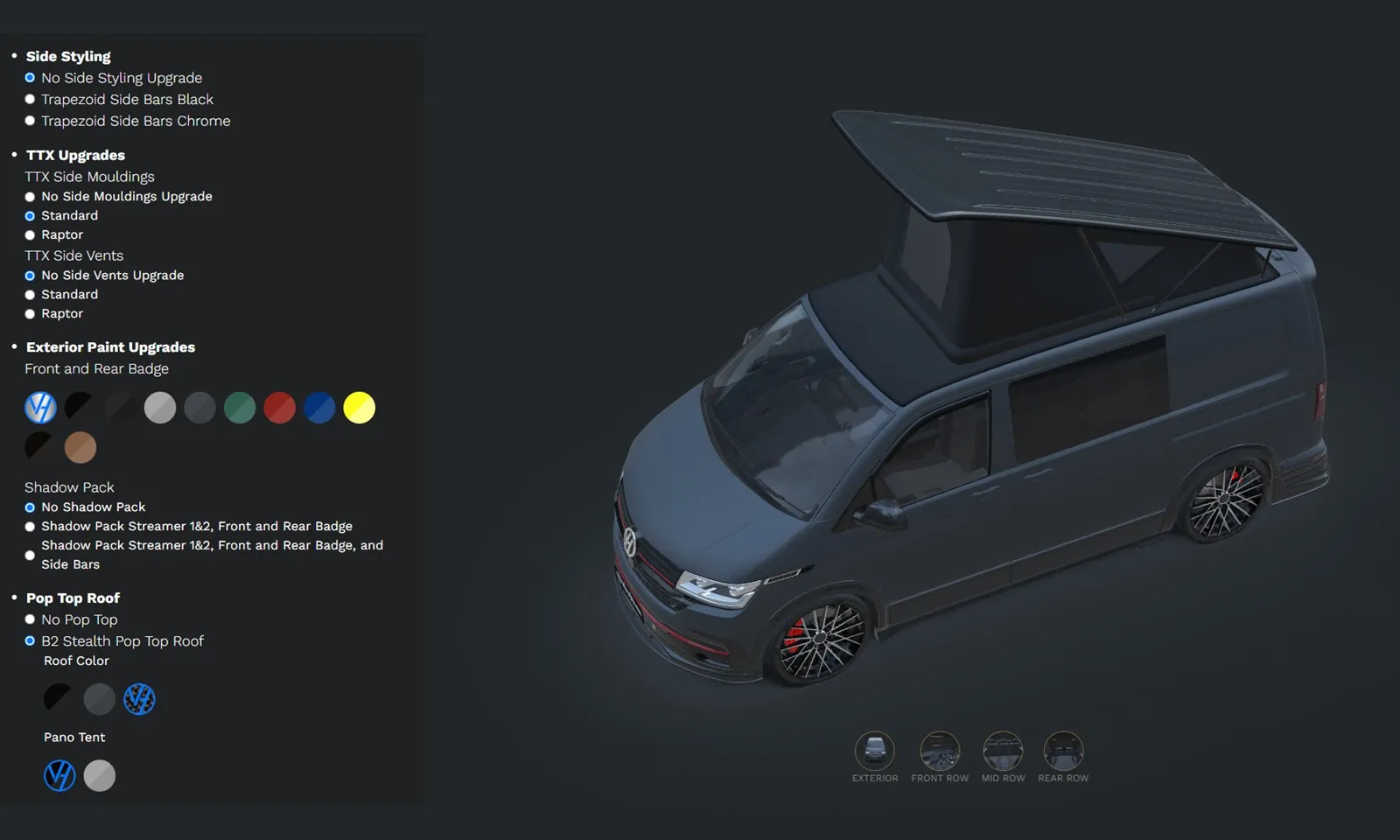
A detail that sounds minor but matters for the experience: the configurator supports dark and light viewing modes. Dark mode provides a dramatic studio-lit presentation that highlights the van's contours and paint finish. Light mode offers a cleaner, more natural view. The customer controls which environment they prefer — a small touch that reinforces the premium feel of the product.
PDF Brochure Generation
Once a customer has designed their van, they can generate a branded PDF brochure of their exact configuration. This serves multiple purposes:
- It gives the customer a tangible takeaway — something to review, share with a partner, or bring to a consultation at VanHaven's HQ
- It bridges the gap between online browsing and the in-person sales process
- It creates a reference document that the sales team can use to quote accurately
The brochure includes rendered images of the configured van from multiple angles, along with a full specification list of every option selected.
Why This Matters for a £100K+ Product
The economics of a 3D configurator are different when the product costs six figures.
For a £20 t-shirt, a configurator is a nice-to-have. For a £105,000 bespoke van, it fundamentally changes the buying dynamic. Here's why.
It Qualifies Leads Before the First Conversation
A customer who has spent twenty minutes configuring their ideal van — selecting their exterior pack, choosing interior leather, exploring wheel options — arrives at a sales consultation already knowing what they want. The conversation shifts from "let me show you what's possible" to "let's refine what you've already designed."
That's a more qualified lead. It shortens the sales cycle, reduces the back-and-forth, and means the design consultants spend their time closing rather than educating.
It Extends the Showroom to Every Time Zone
VanHaven's HQ is in Dorset. Their customers are across the UK and beyond. Not everyone can visit in person — especially early in the buying journey when they're still exploring whether a bespoke VW conversion is right for them.
The configurator operates 24/7. A customer browsing at 11pm on a Tuesday can design their dream van, generate a brochure, and wake up the next morning ready to book a consultation. The configurator did the selling while the showroom was closed.
It Makes the Product Shareable
A configured van is inherently shareable. Partners, family, friends — the people who influence a six-figure purchase decision — can see exactly what's being considered. "Look at this van I designed" is a more compelling share than "look at this van someone else built."
VanHaven actively promotes the configurator on social media. Their 69,000+ Instagram followers can go from admiring a finished build to designing their own in one click. That's a powerful conversion funnel: inspiration to action with no friction in between.
It Differentiates from Every Competitor
The UK custom van market is competitive. Vanworx, Rolling Homes, Coast2Coast Campers, Brown Bird & Co — all produce high-quality conversions. None of them offer a comparable 3D configurator.
When a prospective buyer is comparing conversion companies, VanHaven is the one that lets them design their van online before picking up the phone. That's not a marginal advantage — it's a fundamentally different buying experience. It signals technological sophistication, customer-centricity, and confidence in the product.
Technical Implementation
For development teams and technical decision-makers evaluating a similar project, here's how the configurator was architected.
Rendering Layer
Unlimited3D handles the real-time 3D rendering — model loading, material swapping, lighting, and camera controls. We communicate with the platform via its API to trigger configuration changes, swap materials, reposition cameras, and capture renders for the PDF brochure. This gave us production-quality 3D without building a WebGL rendering pipeline from scratch.
Frontend
The configurator UI is custom-built — the option selectors, the step-by-step configuration flow, the camera view controls, the dark/light mode toggle, and the responsive layout. User preferences are persisted in localStorage so returning visitors pick up where they left off.
Configuration Logic
The business logic layer manages dependencies between options. Selecting a van type determines which wheel sizes are available. Choosing an exterior pack modifies which body components are shown. Interior seating layouts affect which trim options are configurable. This logic runs client-side for instant feedback, with the API layer translating user selections into 3D model state changes.
PDF Generation
The brochure generation system captures the current 3D scene from multiple angles, compiles the selected specifications, and generates a branded PDF — all in-browser. The output is a document the customer can save, print, or email to VanHaven's sales team.
Project Timeline
The core configurator was delivered in approximately three months from kickoff to launch. Post-launch refinements — additional options, UX improvements based on real user behaviour, and expanded van types — extended the total engagement to around five months.
This timeline was achievable specifically because of the technology choice. Using Unlimited3D for the rendering layer meant we could focus development time on the configuration experience, the UI, and the integration — rather than building and optimising a 3D engine. For a Three.js-from-scratch build of equivalent quality, the timeline would have been significantly longer and the budget substantially higher.
What Other Businesses Can Learn from This
VanHaven's configurator isn't unique because of the technology. It's effective because it solves a specific commercial problem: selling a high-value, highly customisable product online.
If your business shares these characteristics, the same approach applies:
- High-ticket products — the higher the price, the more a customer needs to see exactly what they're buying before committing
- High customisation — the more variants you offer, the less practical it becomes to photograph every combination
- Consultative sales process — a configurator doesn't replace the conversation, it makes the conversation more productive
- Strong visual brand — if your product's appeal is partly aesthetic, letting customers see their exact configuration in 3D is a direct competitive advantage
This applies across industries. Automotive, furniture, doors and windows, sports equipment, industrial products — anywhere the customer is choosing from a matrix of options and needs visual confirmation before buying. We applied the same approach for Baseline Courts' 3D basketball court designer — a completely different product, but the same underlying problem.
The Bottom Line
VanHaven's 3D configurator turns passive browsers into active designers. It bridges the gap between social media inspiration and a qualified sales conversation. It works at midnight, it works on mobile, and it communicates the full breadth of VanHaven's product range in a way that no photo gallery ever could.
For a business selling £100,000+ bespoke vehicles, that's not a marketing nice-to-have. It's a core part of the sales infrastructure.
The configurator is live at configurator.vanhaven.co.uk. Try it yourself — design a van, generate a brochure, and see what a 3D configurator can do for a high-value product.
Have a product like this?
Email us the details. We'll map out what a configurator could do for your product — zero obligation.
Start Your ProjectRelated reading