3D Industrial Trailer Configurator Case Study: How Hulck Lets Buyers Configure Heavy-Duty Trailers Online
How we built a 3D industrial trailer configurator for Hulck — a Dutch heavy-duty trailer manufacturer — integrating Expivi's 3D platform with WordPress and WooCommerce to let B2B buyers configure trailers with 23+ attributes and request quotes online.
Hulck builds industrial trailers in the Netherlands — heavy-duty forklift trailers, roll trailers rated to 200 tons, electric platform wagons, and logistic train systems. Their client list reads like a directory of European heavy industry: Tata Steel, ArcelorMittal, Scania, Atlas Copco, Thales, BAM Infra.
Every trailer is custom-built to specification. A forklift trailer for a steel mill has different requirements than one for a food processing plant. Floor type, wheel material, steering system, coupling, load capacity, lighting, walls, tarpaulins, gates, rails — the number of configuration options runs into the dozens.
Selling that complexity online — to operations managers and logistics teams who think in specifications, not brochures — required a tool that could translate 23+ configurable attributes into a visual, interactive experience.
The Challenge
Industrial trailer purchasing is traditionally a slow, specification-heavy process. The buyer knows what they need — a 10-ton forklift trailer with a steel tread plate floor, solid rubber wheels, turntable steering, and fencing on three sides — but communicating that specification to a manufacturer typically involves phone calls, emails, PDF spec sheets, and multiple rounds of clarification.
For Hulck, this created two problems.
First, the sales team spent significant time on the front end of every enquiry — establishing what the customer actually needed before they could quote. For a product with this many variables, that initial scoping conversation is complex and time-consuming.
Second, prospects who were still in the research phase — exploring whether Hulck's product range matched their requirements — had no way to engage with the product interactively. They could read spec sheets and browse the gallery, but they couldn't see their trailer configured to their requirements.
Hulck needed a configurator that would:
- Let B2B buyers specify all 23+ attributes visually, with a 3D preview updating in real time
- Integrate seamlessly with their existing WordPress and WooCommerce infrastructure
- Capture fully specified quote requests — complete with a screenshot of the configured trailer
- Be fast enough that a buyer could configure a trailer in minutes, not hours
The Approach: Expivi + WordPress Integration
Hulck's existing website runs on WordPress with WooCommerce — the same platform that handles their product catalogue, content, and commercial logic. Any configurator solution needed to work within that ecosystem, not replace it.
For the 3D rendering layer, we selected Expivi — a Dutch CPQ (Configure, Price, Quote) platform specialised in 3D product configuration. Expivi provided the real-time 3D engine, the model hosting, and the material system. We then handled everything else: setting up the complete product configuration within Expivi, building the integration layer between Expivi and WordPress/WooCommerce, and ensuring the entire experience worked within the constraints and conventions of the WordPress platform.
This is a pattern that works well when the client has an established website they can't — and shouldn't — abandon. Rather than rebuilding from scratch, you integrate the right rendering platform into the existing infrastructure and focus your development effort on making the integration seamless.
What We Built
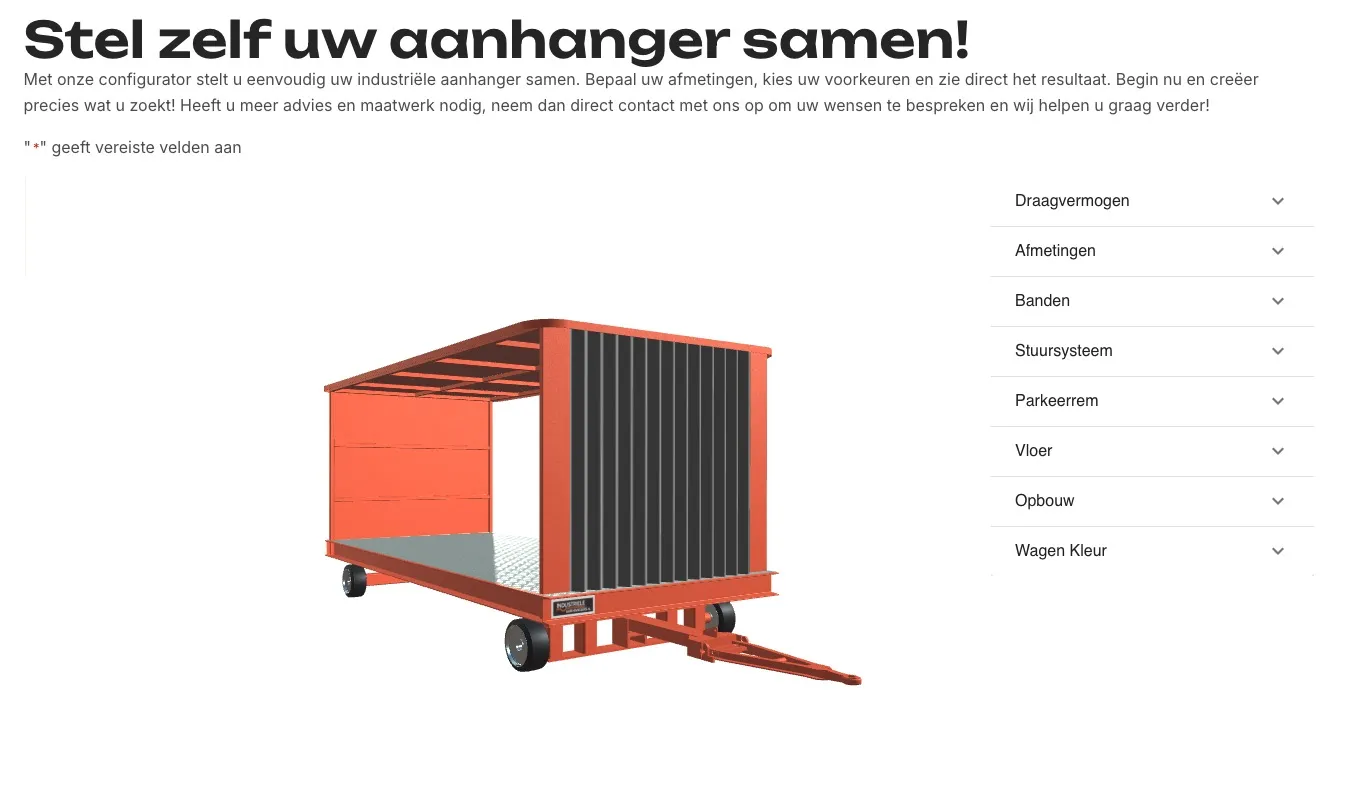
The configurator lives at hulck.com as an integrated page within the existing WordPress site. It presents the full range of trailer configuration options alongside a real-time 3D preview.
23+ Configurable Attributes
Industrial trailers aren't like consumer products with a handful of colour options. Hulck's configurator exposes the full depth of their manufacturing capability:
- Dimensions — length, width, and height, defining the trailer's physical footprint and load area
- Load capacity — from standard to heavy-duty ratings
- Floor type — wood, aluminium, steel tread plate, roller systems, or no floor — each with different weight, durability, and use-case characteristics
- Wheel material and tyre size — solid rubber, air-filled, super-elastic, or polyurethane — chosen based on the operating environment (indoor cleanroom vs. outdoor yard vs. port terminal)
- Steering system — turntable or kingpin (fusee), affecting manoeuvrability and load distribution
- Coupling type — how the trailer connects to the towing vehicle
- Walls and gates — configurable side walls and end gates for cargo containment
- Tarpaulin and cover systems — for weather protection and cargo security
- Rails and tie-down systems — for securing loads during transport
- Parking brake, lighting, reflectors — safety and compliance features
- Colour — frame and component colours to match corporate fleet standards
- Non-marking tyres — a specific requirement for cleanroom and indoor environments where floor marking is unacceptable
Every selection updates the 3D model in real time. Switching from a wood floor to steel tread plate changes the surface material. Adding side walls modifies the trailer geometry. Changing the steering system swaps the undercarriage assembly. The buyer sees exactly what they're specifying — not an abstract list of options, but a visual representation of the trailer they'll receive.
3D Preview with Screenshot Capture
The Expivi-powered 3D viewer renders the configured trailer from any angle, with 360° rotation and zoom. The buyer can inspect the floor surface, check the wheel configuration, verify the wall and gate arrangement — all from their desk, without a site visit or sales call.
When the configuration is complete, the system captures a high-resolution screenshot (1920×1080) of the configured trailer. This screenshot is attached to the quote request, giving the sales team an immediate visual reference for what the buyer specified. No more misunderstandings about "the one with the steel floor and the turntable steering" — the image shows exactly what was configured.
WordPress and WooCommerce Integration
This was the core engineering challenge of the project. Expivi is a standalone platform with its own frontend and API. WordPress is an opinionated CMS with its own conventions for page rendering, form handling, and data management. Making the two work together seamlessly — without breaking either system's expectations — required careful integration work.
The configurator had to:
- Render within a standard WordPress page template, matching the site's existing design and navigation
- Follow WordPress coding standards and hook conventions rather than bypassing them
- Submit quote requests through a form system that integrates with WordPress's data handling
- Capture the configured trailer specification alongside the 3D screenshot and customer contact details
- Work within WooCommerce's product and ordering logic where applicable
The result is a configurator that feels native to the Hulck website. There's no jarring transition between the marketing pages and the configuration tool — it's one continuous experience, built on the same WordPress foundation.
Why This Matters for B2B Industrial Sales
Consumer configurators — for vans, doors, basketball courts — are designed to inspire and excite. They're selling an experience as much as a product.
Industrial configurators serve a different purpose. The buyer isn't browsing for inspiration. They know what they need. The configurator's job is to make the specification process faster, more accurate, and more visual than a phone call or a PDF form.
Specification Accuracy from the First Contact
When a quote request arrives with a fully configured trailer — dimensions, floor type, wheels, steering, walls, coupling, plus a screenshot — the sales team can quote accurately without a scoping conversation. The specification is unambiguous. There's a visual attached. The buyer has already made their selections and confirmed them visually in 3D.
This compresses the sales cycle. Instead of two or three rounds of "did you mean X or Y?" emails, the first conversation can focus on pricing, lead time, and closing the order.
Self-Service for Technical Buyers
Operations managers and logistics engineers are technical buyers. They prefer to evaluate products on their own terms — reading specs, comparing options, and configuring to their requirements — before engaging with sales. A configurator respects that preference.
The buyer can spend twenty minutes configuring different floor types and wheel options at 7am before the sales team has arrived at the office. They can compare a turntable steering setup against a kingpin configuration side by side. They can configure a trailer for their steel mill and another for their warehouse, then submit both as quote requests.
This self-service capability is a direct driver of qualified leads. A buyer who has invested time configuring their exact specification is significantly further along the purchase journey than one who has only read a brochure.
Standing Out in a Traditional Industry
Industrial trailer manufacturing is a sector where most sales still happen through trade shows, catalogues, and personal relationships. Hulck's competitors — both in the Netherlands and across Europe — largely rely on PDF spec sheets and phone-based quoting.
Having a 3D configurator signals that Hulck operates differently. It communicates digital sophistication, customer-centricity, and confidence in the product range. For a growing company competing against established names with decades of history, that signal matters.
Technical Implementation
Rendering Layer
Expivi handles the 3D rendering, model management, and material system. We set up the complete product configuration within the Expivi platform — defining every configurable attribute, the dependencies between options, the 3D model components, and the material variants. This included mapping all 23+ attributes to the correct 3D model behaviours: geometry swaps for structural changes (floor types, walls, steering), material changes for surface finishes (colours, textures), and visibility toggles for optional components (gates, rails, tarpaulins).
Integration Layer
The custom development work focused on the WordPress integration. The Expivi configurator is embedded within a WordPress page and communicates with the WooCommerce backend through a custom integration layer. This layer handles:
- Rendering the Expivi 3D viewer within the WordPress page template
- Synchronising configuration state between the Expivi frontend and WordPress
- Processing form submissions with trailer specifications, screenshots, and customer details
- Routing quote requests into Hulck's existing workflow
Building this within WordPress's conventions — hooks, filters, template hierarchy, and coding standards — was the primary technical challenge. Taking shortcuts (bypassing WordPress's architecture) would have worked in the short term but created maintenance problems as WordPress updates rolled out. We built it properly, and the configurator has continued to run and evolve without compatibility issues.
Project Timeline and Ongoing Development
The initial configurator was delivered in under one month from kickoff to launch. This was possible because the rendering layer was handled by Expivi (no custom 3D engine to build) and the WordPress site already existed (no frontend to design from scratch). The development effort was concentrated on the Expivi setup and the integration layer.
But the project didn't end at launch. Industrial products evolve — new trailer types, new options, new configuration rules. We've continued to maintain and extend the configurator with new features and product updates on an ongoing basis. This long-term relationship is typical of Enterprise and Professional tier projects where the configurator is a living part of the business, not a one-time deliverable.
The advantage of a configurator over static product photography is most apparent here: when Hulck adds a new floor type or wheel option, we update the configurator. With photography, every new option would require a new shoot across every relevant trailer combination.
What Other Businesses Can Learn
Hulck's configurator demonstrates that 3D product configuration isn't limited to consumer products. The same principles — letting customers visualise their exact specification before buying — apply equally to B2B industrial products. In some ways, they apply more forcefully, because:
- Specifications are complex — 23+ attributes with interdependencies. A visual tool reduces errors and misunderstandings that text-based specifications inevitably produce
- Order values are high — a misconfigured industrial trailer is an expensive mistake. Visual confirmation before ordering is worth significantly more when the product costs tens of thousands of euros
- Buyers are technical — they want to self-serve, compare options, and arrive at their specification independently. A configurator respects that workflow
- The sales cycle is long — anything that compresses the specification phase accelerates the entire pipeline
Construction equipment, agricultural machinery, material handling systems, industrial racking, modular buildings — any B2B product where the specification process is manual and error-prone is a candidate for a 3D configurator. For a D2C take on the same Expivi + WordPress approach, see how MrTafel built three furniture configurators with live pricing and AR.
The Bottom Line
Hulck's 3D trailer configurator takes a specification process that traditionally requires phone calls, emails, and multiple rounds of clarification, and compresses it into a single interactive session. The buyer configures their trailer visually, captures a screenshot, and submits a fully specified quote request — all within the existing WordPress site they already know.
For a B2B manufacturer, that's not a marketing gimmick. It's operational infrastructure that generates better-qualified leads, shortens sales cycles, and reduces specification errors on high-value custom products.
The configurator is live at hulck.com. Configure a heavy-duty trailer yourself and see what a 3D configurator can do for industrial B2B sales.
Have a product like this?
Email us the details. We'll map out what a configurator could do for your product — zero obligation.
Start Your ProjectRelated reading