3D Furniture Configurator Case Study: How MrTafel Lets Customers Design Custom Tables and Chairs Online
How we built three 3D furniture configurators for MrTafel — a Dutch custom oak table specialist — integrating Expivi with WordPress and WooCommerce for dining tables, coffee tables, and chairs with live pricing and AR.
MrTafel makes custom oak tables and chairs in the Netherlands. Dining tables, coffee tables, and matching chairs — all made to order in solid oak, herringbone oak, or lived-in oak with open knots. Customers choose the shape, dimensions, thickness, leg style, and finish. Every piece is unique to the buyer.
They're not a luxury brand with showroom prices to match, and they're not budget furniture. MrTafel sits in the sweet spot: handcrafted quality at €200–300 less than comparable competitors, sold direct-to-consumer from their showroom in Zoetermeer and online across the Netherlands.
With 133+ five-star reviews and a growing reputation for quality, the challenge wasn't convincing customers the product was good. It was letting them see exactly what "custom" looked like before committing to a 6–8 week production wait.
The Challenge
Custom furniture has a visualisation problem. When a customer wants a 220×100cm Danish oval dining table in herringbone oak, 4cm thick, on X-frame steel legs with a natural lacquer finish — how do they see that before it's built?
The answer, for most furniture brands, is that they don't. They browse a gallery of past projects, find something close to what they want, and hope the final product matches what they imagined. For a €1,500+ dining table that takes 6–8 weeks to produce and can't be returned because it's made to order, that's a lot of trust to ask for.
MrTafel needed a tool that would:
- Let customers configure their exact table or chair — shape, material, dimensions, legs, finish — and see it in 3D
- Show live pricing that updates with every selection
- Integrate with their existing WooCommerce store for a seamless checkout experience
- Scale to multiple product categories as the range expanded
And because MrTafel's value proposition is affordability without compromising quality, the solution itself needed to reflect that — production-grade, but delivered efficiently.
What We Built
We built three separate 3D configurators, rolled out over time as MrTafel's product range expanded:
- Dining table configurator — the flagship, launched first
- Coffee table configurator — added as the range expanded
- Chair configurator — the most recent addition, covering fabric, colour, and frame options
All three are integrated into MrTafel's WordPress and WooCommerce site, using Expivi for the 3D rendering layer. The same architecture powers each configurator, which made adding new product categories efficient — the integration work was done once, and each new configurator leveraged the same foundation.
Table Configuration: Dining and Coffee Tables
The table configurators are the deepest in terms of customisation options. Customers step through:
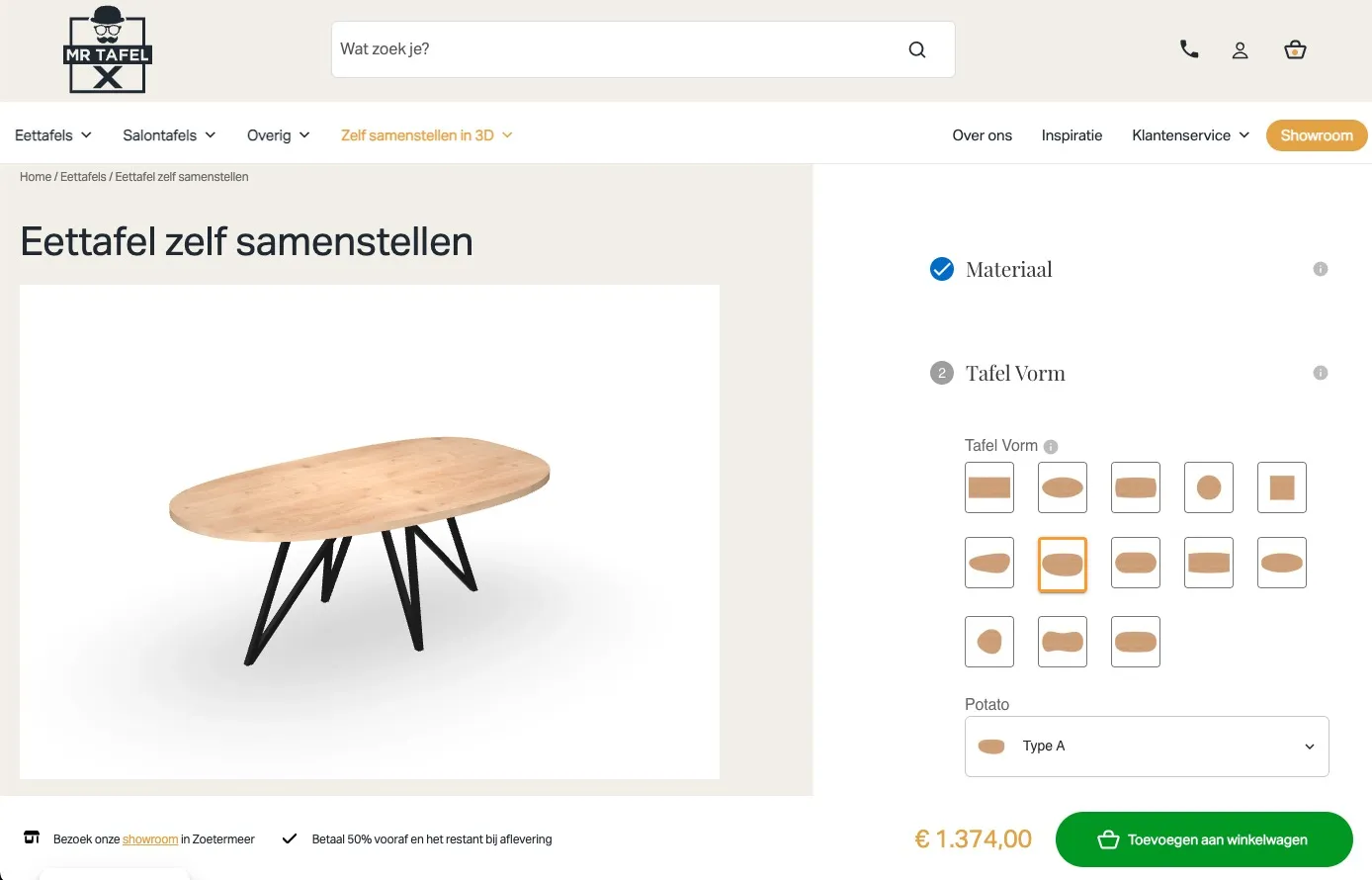
- Shape — rectangular, oval, Danish oval, half-oval, round, and organic forms. Each shape is a distinct 3D model that responds differently to dimension inputs
- Material — solid oak, herringbone (visgraat) oak, or lived-in oak with raw finish and open knots. The coffee table configurator adds a live-edge (boomstam) option. Each material has distinct grain patterns and textures rendered in the 3D preview
- Dimensions — a wide range of length and width combinations, from compact 160×90cm dining tables to large 300×150cm centrepieces. The 3D model scales proportionally
- Tabletop thickness — 3cm, 4cm, or 6cm. A subtle but important visual choice — 6cm thick solid oak has a very different presence than a slim 3cm top
- Leg and base style — A-frame, U-frame, X-frame, V-frame, trapezium, and centre supports, all in steel. Each is a separate 3D component that swaps into the scene
- Finish — multiple lacquer and treatment options that affect the surface appearance of the wood in the 3D rendering
Every selection updates the 3D model in real time. The customer can rotate the table, zoom in on the grain, and examine how their chosen leg style looks from different angles — all before the price updates alongside.
Chair Configuration
The chair configurator takes a different approach. Instead of dimensions and shapes, the key decisions are:
- Fabric and colour — upholstery options that define the chair's visual character
- Frame style — the structural base of the chair, in solid oak to match MrTafel's table range
The configurator lets customers design chairs that complement the table they've already configured — or will configure next. This cross-product coherence is a significant selling point for a brand that specialises in complete dining sets.
Live Pricing
All three configurators display live pricing that updates with every selection. Choosing a larger dimension increases the price. Selecting herringbone oak over solid oak adjusts the cost. Upgrading to a thicker tabletop is reflected immediately.
This pricing transparency is central to MrTafel's brand. They position themselves as the affordable alternative to overpriced custom furniture — and the configurator proves it. There's no "request a quote" wall. The customer sees exactly what their table costs, including the impact of every upgrade, before they add it to their cart.
For a product where price sensitivity is high, this transparency removes the biggest source of hesitation. The customer doesn't need to wonder whether the herringbone upgrade will push the price beyond their budget. They can see it, decide, and either proceed or adjust — all in the same session.
Augmented Reality
The table configurators include an AR feature that lets customers view their configured table in their own home, at actual size, through their phone's camera. This is powered by Expivi's built-in AR capability.
For furniture, AR solves a problem that even the best 3D configurator can't fully address on its own: scale. A 240×110cm dining table looks proportional on screen. But will it fit the room? Will it leave enough space for chairs? Will it overwhelm a small dining area or look lost in a large one?
AR answers those questions by placing the configured table — exact dimensions, exact shape, exact material — directly into the customer's space. It's the closest thing to bringing a tape measure and a sample to the customer's home, without either party leaving their seat.
WordPress and WooCommerce Integration
Like Hulck's industrial trailer configurator, MrTafel's site runs on WordPress with WooCommerce. The configurators needed to live within that ecosystem — not alongside it, but inside it.
The integration means a customer can configure a table in 3D, see the live price, and add it to their WooCommerce cart with the full specification attached — shape, material, dimensions, thickness, legs, and finish. The order flows through WooCommerce's standard checkout process, including MrTafel's 50% deposit payment terms.
Managing three separate configurators within one WooCommerce installation required careful architecture. Each configurator maps to its own product structure, with its own set of configurable attributes and pricing rules. But they share the same integration layer, the same cart logic, and the same checkout flow. This keeps the customer experience consistent whether they're configuring a dining table, a coffee table, or a chair.
Why It Works for MrTafel's Business
Removing the Imagination Gap
The single biggest barrier to selling custom furniture online is the gap between what the customer imagines and what they'll receive. A herringbone oak tabletop looks very different from a solid oak one. An X-frame base creates a different aesthetic than a U-frame. A 3cm top feels modern and minimal; a 6cm top feels substantial and rustic.
Static photography can show a few of these combinations. A 3D configurator shows all of them — on demand, in any combination the customer chooses. The imagination gap closes. The customer sees their table, not someone else's.
Driving Higher Average Order Values
Configurators naturally encourage upgrading. When a customer can toggle between solid oak and herringbone oak and see the visual difference alongside the price difference, the upgrade sells itself. When they can switch from a 3cm top to a 6cm top and see how it transforms the table's presence, the thicker option suddenly feels worth the extra cost.
This isn't upselling through pressure. It's upselling through clarity. The customer makes an informed decision because they can see and price the difference in real time.
Scaling the Product Range Efficiently
MrTafel started with dining tables. As the business grew, they added coffee tables and then chairs. Because the integration architecture was built once — Expivi to WordPress to WooCommerce — each new configurator was faster to launch than the last.
This is a practical benefit of the platform approach. The rendering layer (Expivi), the integration layer (custom WordPress), and the commercial layer (WooCommerce) are all established. Adding a new product category means setting up new 3D models and configuration options in Expivi, then connecting them to the existing infrastructure. The heavy lifting was done the first time.
Competing in a Crowded Market
The Dutch custom table market isn't short on competitors. Table du Sud, De Bommel Meubelen, Tulmans — several brands offer similar products with similar configurators. MrTafel differentiates on price-quality ratio and the breadth of their configurator experience.
Having three configurators — covering the full dining set from table to chairs — means a customer can design their entire dining room in one session. That's a more complete experience than competitors offering a table configurator alone. When the customer has already designed their chairs to match their table, buying from a competitor means starting over.
Technical Implementation
Rendering Layer
Expivi handles the 3D rendering, model hosting, material system, and AR functionality across all three configurators. We set up the complete product configurations within Expivi — defining each shape variant, material texture, dimensional scaling behaviour, leg/base component, and finish option. The AR feature is an Expivi built-in capability that we enabled and configured for MrTafel's products.
Integration Layer
The custom development focused on the WordPress and WooCommerce integration — the same pattern used for Hulck's trailer configurator, but extended to support three product categories within a single WooCommerce store. The integration handles:
- Embedding the Expivi 3D viewer within WordPress page templates
- Synchronising configuration state with WooCommerce product and pricing logic
- Adding fully specified configured products to the WooCommerce cart
- Managing three distinct configurator instances with shared infrastructure
Pricing Engine
Live pricing is calculated based on the selected configuration — dimensions, material, thickness, leg style, and finish all affect the final price. The pricing logic integrates with WooCommerce so that the price displayed in the configurator matches the price at checkout. No surprises, no recalculation — what the customer sees is what they pay.
Project Timeline
The initial dining table configurator was delivered in under one month. Subsequent configurators (coffee tables, then chairs) were added over time as MrTafel expanded their product range — each one faster than the last because the integration foundation was already in place.
This phased approach is worth noting for businesses evaluating a 3D configurator investment. You don't need to configure your entire product range on day one. Start with your core product, validate the approach, and expand from there. The architecture supports it — and the initial investment pays forward into every subsequent configurator.
What Other Businesses Can Learn
MrTafel's configurator strategy demonstrates two things worth noting.
First, configurators compound. The first one is the biggest investment. The second and third leverage the same architecture, the same integration, and the same operational knowledge. For businesses with multiple product categories, the long-term cost per configurator decreases significantly.
Second, pricing transparency converts. In a market where customers are price-sensitive and comparison-shopping is easy, showing the price in real time — not hiding it behind a quote request — removes friction and builds trust. MrTafel's "€200–300 cheaper" positioning is most powerful when the customer can verify it themselves, live, in the configurator.
These principles apply to any D2C business selling customisable physical products: furniture, kitchens, cabinetry, shelving, outdoor structures — anywhere the customer wants to see what they're getting and know what it costs before they buy.
The Bottom Line
MrTafel's three 3D configurators turn a complex custom furniture purchase into a visual, self-service experience. Customers design their exact table — shape, wood, dimensions, legs, finish — see the price, view it in AR in their own dining room, and add it to their cart. Then they do the same for a coffee table and a set of chairs.
For a growing D2C brand competing on quality and value, that's not just a feature. It's the core of the online buying experience.
Try it yourself: design a dining table, a coffee table, or a chair — and see what a 3D furniture configurator can do for a custom product business.
Have a product like this?
Email us the details. We'll map out what a configurator could do for your product — zero obligation.
Start Your ProjectRelated reading